You are attested as a Financial Advisor / Intermediary, but this page is intended for a Institutional Investor.
You are attested as a Borrower, but this page is intended for an Institutional Investor.
You are attested as an Individual Investor, but this page is intended for an Institutional Investor.


- Renewables come first, but selective transition credit still has a role.
- Bridge fuel finance works only if it replaces a dirtier asset and leads to a cleaner end state.
- Credible transition debt needs clear emissions gains, milestones and guardrails.
Renewables First, But Not Only
Renewables remain the preferred decarbonisation pathway, and a portfolio committed to climate alignment should prioritise them accordingly. But a categorical refusal to finance any new fossil fuel asset can slow the energy transition rather than accelerate it, in specific cases. This note identifies several scenarios in which a less carbon-intensive fossil investment can credibly displace a more carbon-intensive incumbent fuel and shorten the runway to a low-carbon endpoint. This serves as a pragmatic, near-term alternative to not yet commercially viable zero carbon fuels or a renewables-only buildout that cannot scale fast enough or is constrained by other factors.
Global transition bond issuance reached a record $20 billion in 2024, clustered in places like Japan, where renewables face structural constraints due to land scarcity and a lack of grid interconnections, enabling gas to play a central role in the energy mix. Dated retirement and conversion milestones and substituting a more carbon-intensive fuel with a lesser option are features that distinguish credit, worthy of underwriting as transition debt. Adding these features can help these investments sit comfortably within some climate-oriented portfolios.
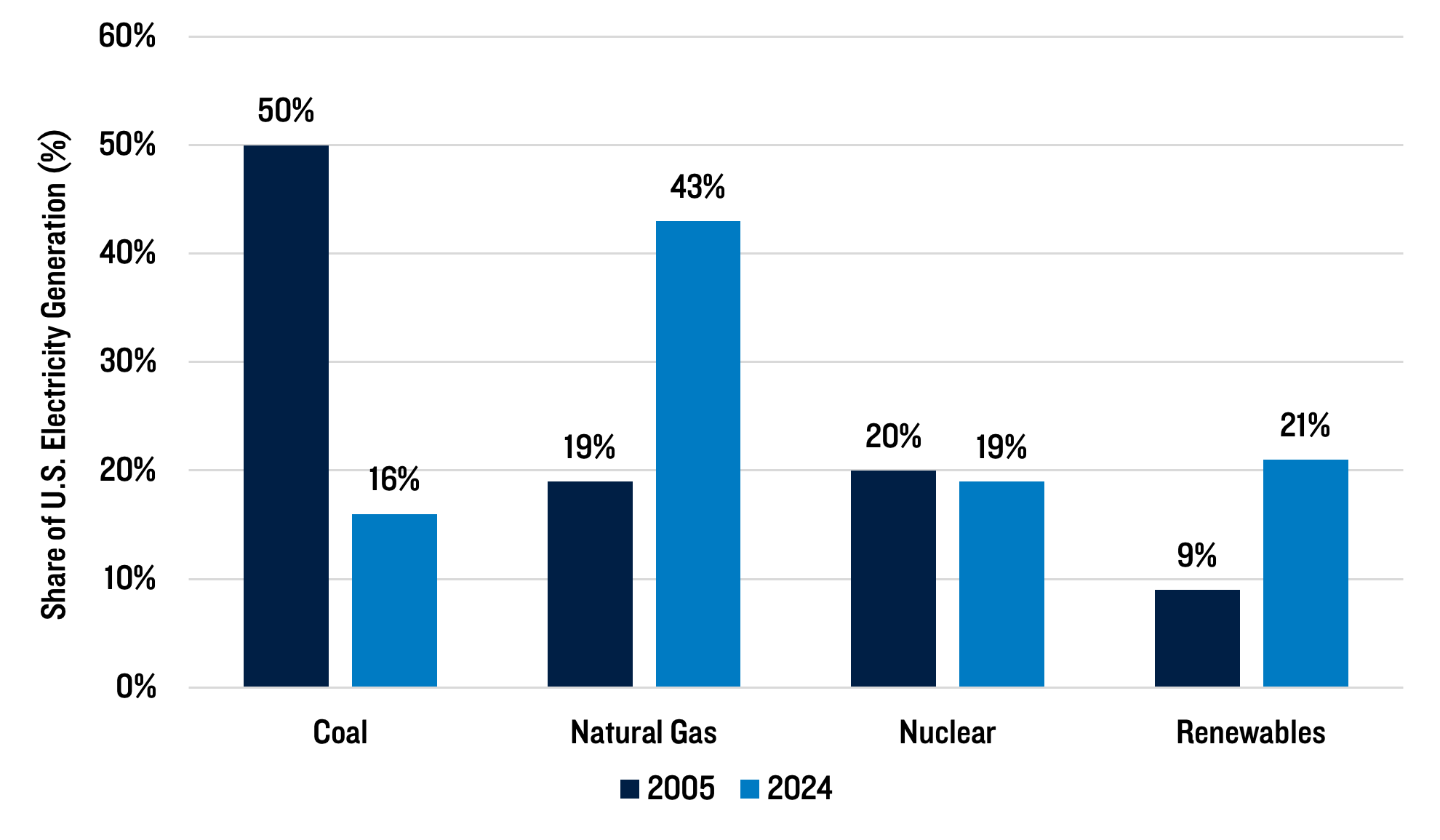
The historical record is instructive. Between 2005-2024, U.S. power sector CO₂ emissions fell approximately 41%, driven by a generation mix shift in which coal’s share collapsed from 50% to roughly 16%, while natural gas grew from 19% to 43% and renewables more than doubled from 9% to 21% (Figure 1) . The Environmental Information Association’s analysis of the 2005–2019 portion of that decline attributes two thirds of the drop to coal-to-gas switching and less than a third to renewables growth. This highlights that fuel substitution from higher to lower emitters can produce a measurable and persistent decline in absolute emissions.
A Changing Mix
U.S. electricity generation mix shift, 2005 vs. 2024. Power-sector CO₂ emissions fell ~41% over the period.
#1: Fixing The Methane Problem:
Abatement, Distribution Modernisation, and Easements
A strong case for transitional fossil finance is fixing the leaks and failure-prone segments in existing infrastructure. Methane’s 20-year global warming potential (GWP) score is approximately 83, meaning that one ton of methane released into the atmosphere traps roughly 83 times as much heat over a 20-year period as one ton of carbon dioxide, the most abundant greenhouse gas. This is why methane leakage from wells, pipelines, and compressors is so potent and mitigating that a high-impact opportunity. The IEA’s 2025 Global Methane Tracker estimates that roughly 25 Mt of upstream oil and gas methane emissions and approximately 35 Mt across the full fossil fuel sector could be abated at no net cost worldwide.
The U.S. gas distribution network offers a clear case for targeted replacement. Much of the cast and wrought iron infrastructure, installed before 1950, has materially higher failure and leakage risk than modern alternatives. Although cast iron mains represent only about 1% of U.S. distribution main mileage, data from the Pipeline and Hazardous Materials Safety Administration (PHMSA) indicate they account for 8% of all distribution main incidents and 33% of all fatalities involving distribution mains.
Replacement programmes therefore deliver dual benefits within a single capital allocation: the same segments that pose safety risks are also persistent sources of fugitive methane, allowing operators to capture measurable emissions reductions alongside upgrades. Baseline and post-intervention leakage data strengthen attribution, while investments in detection, efficiency and retrofit improves system resilience.
Crucially, such capex does not necessarily expand fossil fuel demand. Midstream easement diversions, for instance, reroute flows around sensitive or congested areas without increasing capacity or throughput. The effect is risk reduction and emissions mitigation on existing infrastructure, positioning capex as a tool for optimisation rather than growth.
#2: Gas For Coal: Pairing Peaker Plants with Renewables
As coal exits and renewables scale, system reliability is emerging as a key constraint. Wind and solar remain inherently intermittent, while current battery deployment supports only short-duration storage, leaving multi-day gaps in cloudy or low-wind periods. Coal is valued for its ability to provide baseline generation, but gas “peaker” units – power plants that are built to ramp-up fast and run only during short term demand and supply gaps – pair naturally with renewables and provide the flexibility to reduce reliance on coal. Coal-fired generation emits roughly 2,250 lb CO₂/MWh on average, against 870 lb CO₂/MWh for a modern combined-cycle gas plant and 1,000 to 1,400 lb CO₂/MWh for a simple-cycle gas peaker. Importantly, a peaker operating at sub-10% capacity generates only a fraction of the absolute emissions of the baseload coal unit it replaces and improves overall system economics.
The dynamic is already visible in practice: a Western U.S. cooperative has accelerated the retirement of approximately 1.8 GW of coal capacity by 8 to 12 years, replacing it with a portfolio of wind, solar, storage and a smaller block of fast-ramping gas capacity sized to cover residual reliability need. The principal risk is reversibility. Through 2025, coal retirements have already been delayed in some cases, driven in part by incremental energy demand from data centres and regulatory intervention. Two key actions can be taken to address this. First, peaker financing should be paired with legally binding coal-retirement dates, ideally embedded in regulator approved investment resource plans (IRPs) or settlement agreements, and where possible securitised through ratepayer-backed bonds that convert retirement promises into hard debt service. Secondly, contractual limits on peaker utilisation are essential to prevent drift into routine generation. Taken together, these actions ensure the peaker is funding a coal exit, not extending a coal plant’s life.
#3: The Switching Solution in Hard to Abate Sectors
Switching from coal to gas in industrial heat can deliver immediate, measurable emissions reductions while preserving the option to convert to hydrogen or electrification as those technologies mature.
The case is the strongest when the switch is explicitly structured as a bridge, not a permanent fuel choice. In steelmaking, the dominant blast furnace-basic oxygen furnace route emits roughly 1.9-2.3 tonnes of CO₂ per tonne of steel, largely from coking coal whereas direct reduced iron using natural gas lowers intensity by roughly a third on a cradle-to-gate basis. Using hydrogen as the reductant drops it by over 95%, though green hydrogen at the scale and cost required is not currently commercially available.
Recent capital plans among European producers illustrate these provisional arrangements. A major integrated European steelmaker announced in 2023 an approximately €1bn investment to convert a site to green hydrogen-DRI with a hybrid electric arc furnace and a binding hydrogen procurement ramp. A northern German producer is constructing a 2.5 Mt/yr DRI plant scheduled to start on natural gas in 2026 and convert to hydrogen on a dated milestone schedule. A Swedish first-mover is building a greenfield hydrogen-DRI plant, structured around fully renewable inputs from commissioning.
The bigger risk is path dependency. An industrial fuel switch without a credible ramp to hydrogen, electrification, or another zero-carbon endpoint is not transition credit. Analysts have flagged this risk directly, noting that gas-based DRI, for example, cannot itself deliver steel decarbonisation, absent a credible hydrogen pathway . Financeable transactions in this category share three features: a dated electrification timeline or hydrogen ramp specifying minimum percentage of feedstock by year, a meaningful capex commitment to electrolysis and renewable power procurement, and covenant restrictions against extending the gas-fired phase past the conversion milestone.
A Bridge Too Far
A bridge that does not arrive at the other side is not a bridge. Renewables remain the best option to power economy-wide decarbonisation initiatives, and a portfolio committed to climate alignment should continue to prioritize them accordingly.
But the thrust of this article is that in a narrow set of real life case studies, the cleanest available substitute for a high-emitting incumbent is itself a fossil asset, and refusing to finance that substitute on principle leaves the dirtier asset in service longer.
The three different examples thread a common logic. It is a vote for the displacement of a higher-emitting incumbent on a faster timeline than the renewables-only path could deliver. The cleanest path to the cleaner grid is rarely a straight line, and savvy money managers can distinguish the bridge that arrives from the one that does not.
References
1 Moody's Ratings, "Sustainable Bond Issuance to Hold Steady at Around $1 Trillion in 2025," January 2025 (as reported by ESG Today). Available at: https://www.esgtoday.com/moodys-predicts-1-trillion-sustainable-bond-market-in-2025-despite-political-headwinds/. Transition bonds debuted at scale in 2024 with the Japanese government's $11 billion inaugural issuance, anchoring a record $20 billion in global transition bond volume, with Japan accounting for over 85% of the segment. Moody's projects transition bond issuance to roughly double to $40 billion in 2026 as the label diversifies beyond Japan.
2 Center for Climate and Energy Solutions, “U.S. Emissions,” updated February 2026 (citing EIA data through 2024). Available at: https://www.c2es.org/content/u-s-emissions/. The 41% decline in U.S. power-sector CO₂ emissions from 2005 through 2024 reflects a combination of coal-to-gas substitution, growth in wind and solar, and roughly flat electricity demand.
3 U.S. Energy Information Administration, “Electric power sector CO₂ emissions drop as generation mix shifts from coal to natural gas,” Today in Energy, August 4, 2021. EIA’s decomposition for 2005–2019 attributes 532 Mt (65%) of the 819 Mt power-sector CO₂ decline to coal-to-gas switching and 248 Mt (30%) to renewables growth. Available at: https://www.eia.gov/todayinenergy/detail.php?id=48296
4 International Energy Agency, Global Methane Tracker 2025: Key Findings (March 2025). The IEA estimates that ~25 Mt of upstream oil and gas methane emissions could be abated at no net cost in 2024, and ~35 Mt across the full fossil fuel sector. Methane’s 20-year global warming potential is approximately 84 times that of CO₂ (IPCC AR6).
5 U.S. Pipeline and Hazardous Materials Safety Administration (PHMSA), “Cast and Wrought Iron Inventory,” 2024 update. Cast iron mains represent ~1% of U.S. distribution mains but account for 8% of incidents and 33% of all distribution-main fatalities. Available at: https://www.phmsa.dot.gov/data-and-statistics/pipeline-replacement/cast-and-wrought-iron-inventory
6 U.S. Energy Information Administration, “Electric power sector CO₂ emissions drop as generation mix shifts from coal to natural gas,” Today in Energy, August 4, 2021 (coal: 2,257 lb CO₂/MWh; natural gas: 976 lb CO₂/MWh). Combined-cycle figure of approximately 870 lb CO₂/MWh from NOAA stack-monitoring analysis, 1997–2012 average. Simple-cycle gas peaker emissions range of 1,000–1,400 lb CO₂/MWh from U.S. Environmental Protection Agency, Simple Cycle Stationary Combustion Turbine EGUs Technical Support Document (May 2023); the higher end of the range reflects increased start/stop cycling at low capacity factors. EPA’s regulatory benchmarks corroborate the comparison: existing coal units 1,305 lb CO₂/MWh, existing gas units 771 lb CO₂/MWh.
7 U.S. Department of Energy and DOE Loan Programs Office disclosures on coal-plant securitization structures; see also state public utility commission filings on ratepayer-backed bond authorizations for accelerated coal retirement (multiple jurisdictions, 2022–2024).
8 Argonne National Laboratory / U.S. Department of Energy, "Cost and Life Cycle Analysis for Deep CO₂ Emissions Reduction for Steel Making: Direct Reduced Iron Technologies," 2023. Cradle-to-gate life cycle assessment finds that natural-gas-based DRI reduces CO₂ emissions by approximately 33% versus blast furnace-basic oxygen furnace (BF-BOF) steelmaking; using hydrogen as the reductant cuts emissions by over 95%. See also peer-reviewed analysis in Sci. Direct, "Direct reduction of iron to facilitate net zero emissions in the steel industry," January 2024, which places gas-DRI emissions reductions versus BF-BOF in the 33-38% range.
9 Institute for Energy Economics and Financial Analysis (IEEFA), "Hydrogen unleashed: Opportunities and challenges in the evolving H₂-DRI-EAF pathway beyond 2024," February 2024. IEEFA notes that gas-based DRI is "not a definitive solution for achieving steel decarbonisation due to its significant carbon emissions" absent a credible pathway to hydrogen substitution.
You May Also Like
-
Seeing the Wood for the Trees: A Pragmatic Approach to Biodiversity for Investors and IssuersUnderstand the real risks posed by biodiversity loss and implement a strategy built for resilience and long-term performance.
Read More
-
 Green Securitisation: From Policy Ambition to Scalable Financing Channel
Read More
-
PGIM Policy Insights: Improving the SFDRThe Sustainable Finance Disclosure Regulation (SFDR) has carved a new path by requiring ESG disclosure for asset managers.
Read More